
Attwater Research Group
UCL Department of Chemistry
Artwork: @RuneKidmose
We are exploring chemistry and catalysis in RNA molecules.
Our group is based in the Department of Chemistry at UCL.
At the molecular level, biology is built around RNA. We want to understand why – in essence, why life chose RNA, and why RNA chose life.
To do this, we evolve and engineer new RNA sequences with catalytic activity. We also characterise the broader systems chemistry and behaviour of RNA molecules.
We want to understand how RNA contributed to the early stages of biology, and whether features of modern biology reflect behaviour of primordial RNA.
More broadly, we want to see what roles biopolymers such as RNA can play both at the origins of life and in synthetic biological systems.
At a practical level, we are combining molecular evolution and aqueous organic chemistry to tackle three questions:
Can molecules exhibit biological behaviour?
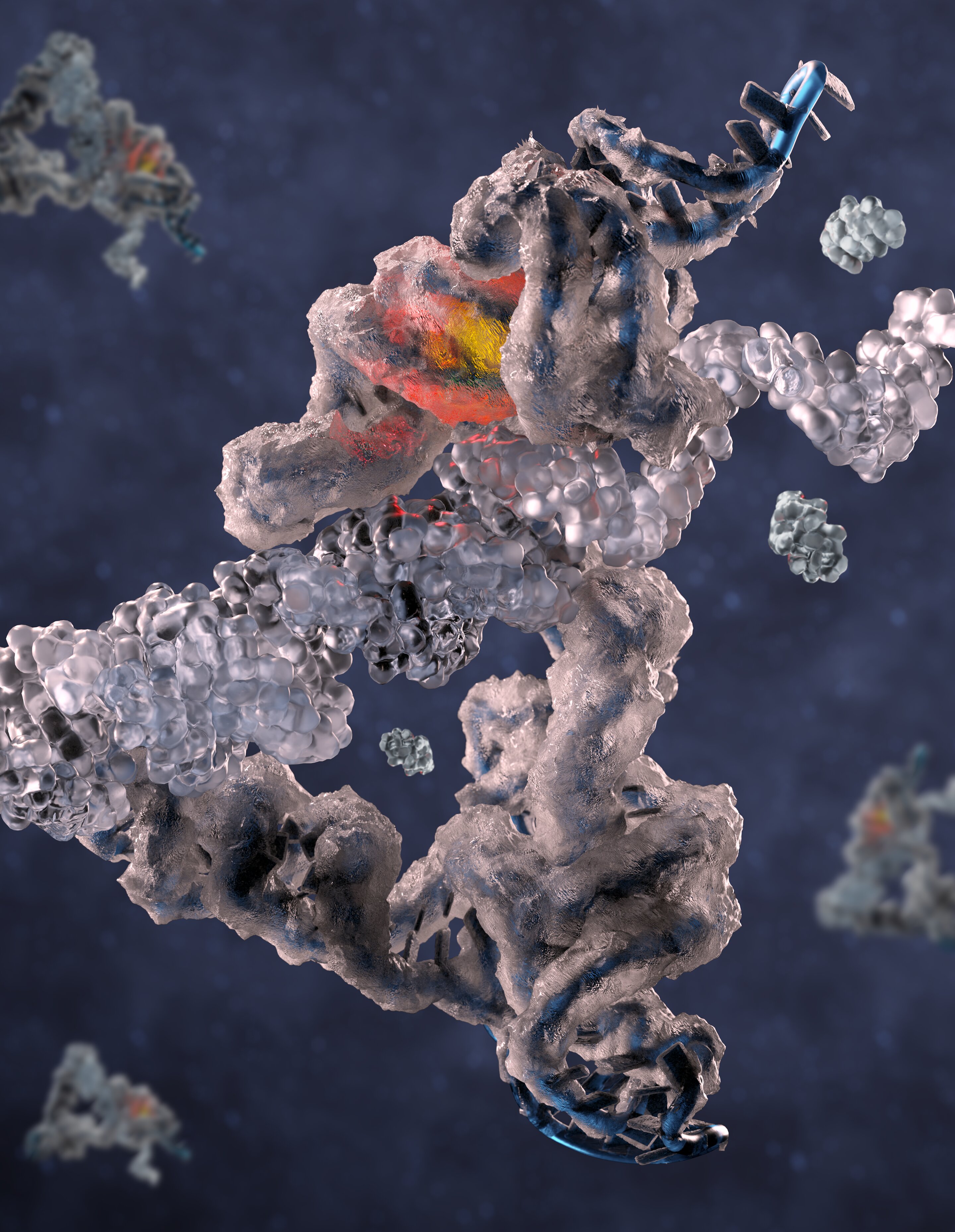
An RNA that synthesises RNA
Artwork: @RuneKidmose
We have developed catalytic RNA molecules – ribozymes – that can copy RNA sequences1,2. These RNA polymerase ribozymes transmit genetic information through the generations, like protein polymerases do in biology. However, in other respects – such as their use of 3-letter building blocks – these ribozymes behave more like biology’s ribosomes, suggesting that primordial biology worked differently. We are using physicochemical cycles to get these molecules to exponentially replicate parts of themselves3, and find a route to self-replicating molecules as a model of nascent biology.
Can ribozymes catalyse prebiotic chemistry?

Protocell concept
The chemical pathways harnessed by early biology may have been different to those that succeeded them in modern biology. We collaborate with the Powner group at UCL Chemistry to understand the impact of potentially prebiotic chemistries4 upon the molecular ecology of RNA. We are particularly interested in whether such chemistries can confer additional capabilities upon ribozymes, and which catalytic opportunities ribozymes might evolve to exploit. We hope to build a better picture of the early development of RNA-based life in its chemical and geological context.
Can we narrow the gap between chemistry and life?

Ice eutectic phase microstructure
There is a forbidding gulf between the transience of chemistry, and the complexity needed to kick-start RNA-based life. But opportunities exist to narrow this gap: geochemical environments5, peptides6, systems chemistry, and sequence pool behaviours1,3 could help heritable function arise more easily from chemical systems, and contribute to plausible models for the emergence of early biology. Testing the limits of RNA catalysis and evolution could suggest new ways to apply the power of evolution in simple systems and in a broader polymer chemical space.
We are grateful for the support for our research from the following organisations:




References
- Attwater, J.; Raguram, A.; Morgunov, A. S.; Gianni, E.; Holliger, P. Ribozyme-catalysed RNA synthesis using triplet building blocks. eLife 2018, 7. DOI: 10.7554/eLife.35255.
- McRae, E. K. S.; Wan, C. J. K.; Kristoffersen, E. L.; Hansen, K.; Gianni, E.; Gallego, I.; Curran, J. F.; Attwater, J.; Holliger, P.; Andersen, E. S. Cryo-EM structure and functional landscape of an RNA polymerase ribozyme. PNAS 2024, 121 (3). DOI: 10.1073/pnas.2313332121.
- Attwater, J.; Augustin, T.; Curran, J. F.; Kwok, S.; Gianni, E.; Holliger, P. Trinucleotide building blocks enable exponential ribozyme-catalysed RNA replication and open-ended growth of diverse RNA sequence pools. bioRxiv 2023, 2023.2003.2017.533225. DOI: 10.1101/2023.03.17.533225.
- Foden, C. S.; Islam, S.; Fernandez-Garcia, C.; Maugeri, L.; Sheppard, T. D.; Powner, M. W. Prebiotic synthesis of cysteine peptides that catalyze peptide ligation in neutral water. Science 2020, 370 (6518), 865-869. DOI: 10.1126/science.abd5680.
- Attwater, J.; Wochner, A.; Pinheiro, V. B.; Coulson, A.; Holliger, P. Ice as a protocellular medium for RNA replication. Nature Communications 2010, 1 (6), 76. DOI: 10.1038/ncomms1076.
- Tagami, S.; Attwater, J.; Holliger, P. Simple peptides derived from the ribosomal core potentiate RNA polymerase ribozyme function. Nature Chemistry 2017, 9 (4), 325-332. DOI: 10.1038/nchem.2739.
Attwater Research Group
UCL Department of Chemistry,
20 Gordon Street,
London WC1H 0AJ
j.attwater[at]ucl.ac.uk
 Attwater Research Group